Archives

DNA matching changes at Ancestry.com

All my favorite bloggers have posted good articles about the changes in the Ancestry.com DNA pages. I have put a list of them at the end of this post.

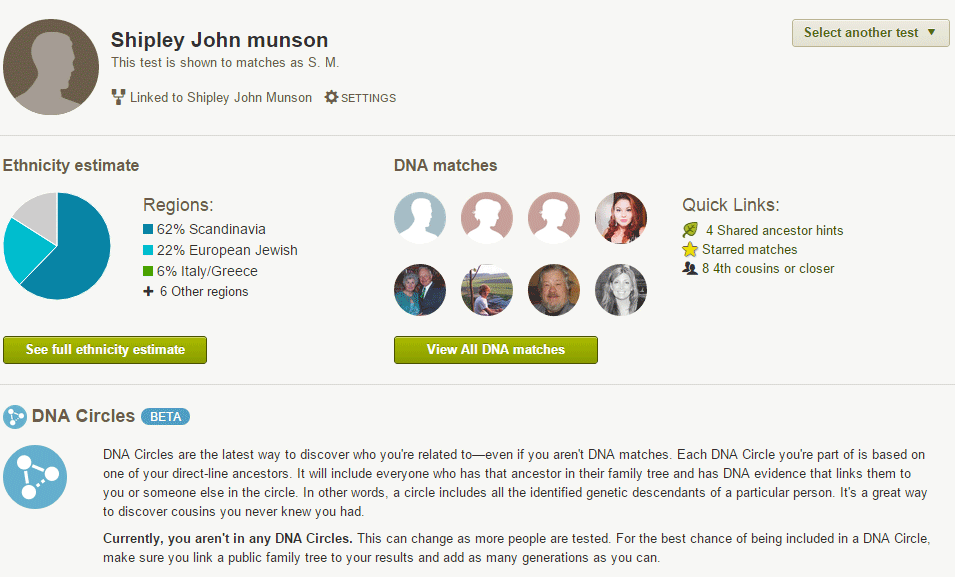
The improvement in Ancestry’s DNA matching has greatly reduced the total number of matches, which ran into the thousands for many of us. The theory is that their new algorithm has gotten rid of those matches that were unlikely to share a common ancestor in the genealogical time frame. I am hopeful. And the new DNA home page for a person is much nicer looking and more informative as you can see below.

NewAncestryDNAHomeSmll

Looking at how my brother with one Jewish grandparent has fared, all his 4th cousin Jewish matches (dozens of those) are gone. This is probably correct. The few that I have been in contact with are not recently related.

Continue reading

Using Ashkenazi Jewish DNA to Find Family

Reading about this holocaust survivor’s discovery of missing family via DNA had me crying –
http://www.ynetnews.com/articles/0,7340,L-4589762,00.html – but it also got me thinking about how few jewish DNA success stories there are. Perhaps that is changing now that more people are testing.
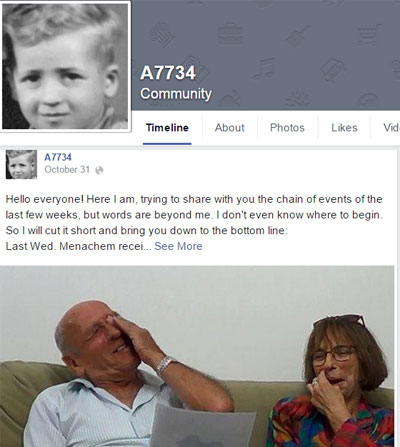
A7734 on facebook
The screenshot at the left is from facebook page A7734 about Menachem’s search. It shows him and the genealogist who helped him, looking at the first picture of his parents he had ever seen.

Frankly, success stories with jewish DNA are rare.  I have none to report from my family. I emailed all my Ashkenazi researching friends to see if anyone had a good success story. Not very many are out there. If you have one, please send it along.

The endogamous nature of jewish DNA is part of the problem. Everyone looks like a close relative in the DNA matching. Another part of the problem is that so few Ashkenazim know their ancestors past their great-grandparents. Too many records were destroyed in WWII, among other problems researching.

In my experience, if an Ashkenazi Jewish (AJ) DNA match is not showing as a 2nd cousin or better it is unlikely that you will find the relationship. An experienced Israeli researcher told me to ignore anyone without at least one long segment match of 23 cM.

Below are a few tips from search angel Gaye Tannenbaum who frequently works with AJ DNA.

Continue reading

The DNA behind the PBS show “Finding Your Roots”

On Tuesdays, I usually count down the hours until the latest episode of Finding Your Roots is on, but tonight we will be watching election returns while my DVR records the show. So you all know what I will do when my husband finally heads for bed …

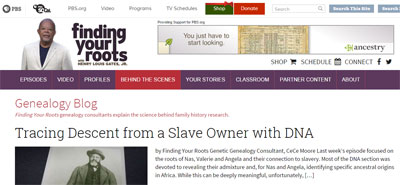
FindingRootsBlog

It looks like tonight’s show will showcase the ancestry of a number of jewish celebrities. Since Ashkenazi research can be particularly difficult and the DNA very tricky due to that population’s endogamy, I am particularly interested to see what I can learn.


Cece Moore‘s latest blog entry at the PBS site was just posted. Each week she discusses some of the details of the DNA work she did for the previous show.
Continue reading

When is a DNA segment match a real match? IBD or IBS or IBC?

The current technology for personal genome testing cannot tell you which of the two chromosomes, maternal or paternal, in a pair that an allele comes from. It can tell you that there is an AG at a specific position and a CT at the next position but not whether the A came from your mother or your father. This leads to much confusion about DNA segment matching.
ShipleyKittyDancingSmll

Kitty and Shipley; siblings sharing 47% of their DNA

The matches that these testing companies find are for stretches of DNA that are half identical regions (HIRs). This is due to the fact that a relative who shares a DNA segment from a common ancestor with you will match you along the chromosome you got from the parent who is descended from that ancestor. Thus your new relative will match you for half the alleles in those positions. Only a sibling will share fully identical regions of DNA. Click here for a page that has a picture of the DNA I share with my brother Shipley.

For example, if my Dad gave me AAAAAAAAAAA and my Mom gave me CCCCCCCCCCC then I would seem to match absolutely everyone on that segment because every position has both an A and a C. So an ACACCAACCAC or a CCAACCCACA looks like a match, but only those with an  AAAAAAAAAAA or a  CCCCCCCCCC would be real matches. This is simplistic and the segment runs used for matching are much longer than this to try to avoid that sort of false matching. Also note than when your testing company shows an AC it is really an AT and a CG but just one of the known pairing is shown for brevity.

The term for a real match is IBD, which is an abbreviation for Identical By Descent. The term IBS means Identical by State which would apply to any false match. So in our example, the CCAACCCACAA match would be considered IBS.

Continue reading

New Utilities at GEDmatch: Tier 1 for paid members

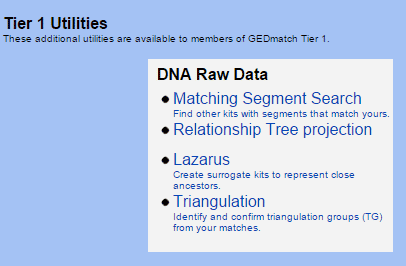
There are four exciting new utilities at GEDmatch.com which I plan to cover in depth over the next several days. These are only available to for people who have donated  at least $10 (every additional $10 gets you these for another month). A good way for GEDmatch to pay for their extra server costs. The rest of the site will remain free. The utilities are:
Tier1

  1. A Matching Segment Search – Get a list of all your segment matches suitable for cutting and pasting into a spreadsheet
  2. A Relationship Tree projection – calculates probable relationship paths based on Autosomal and X-DNA Genetic Distances. It is experimental, try it and give them feedback
  3. Lazarus – Construct a kit to represent a close ancestor, wow!
  4. Triangulation – takes your top 300 matches and finds which ones match each other with details. The format can be copied to a spreadsheet

Continue reading