Archive | 2026

Further experiments with AI and genealogical documents

A recent 2nd cousin DNA match (click here for that story) inspired me to explore German records from Bavaria. So I decided to try AI to read the handwriting and translate it. First however, I did some more work on my Norwegians.

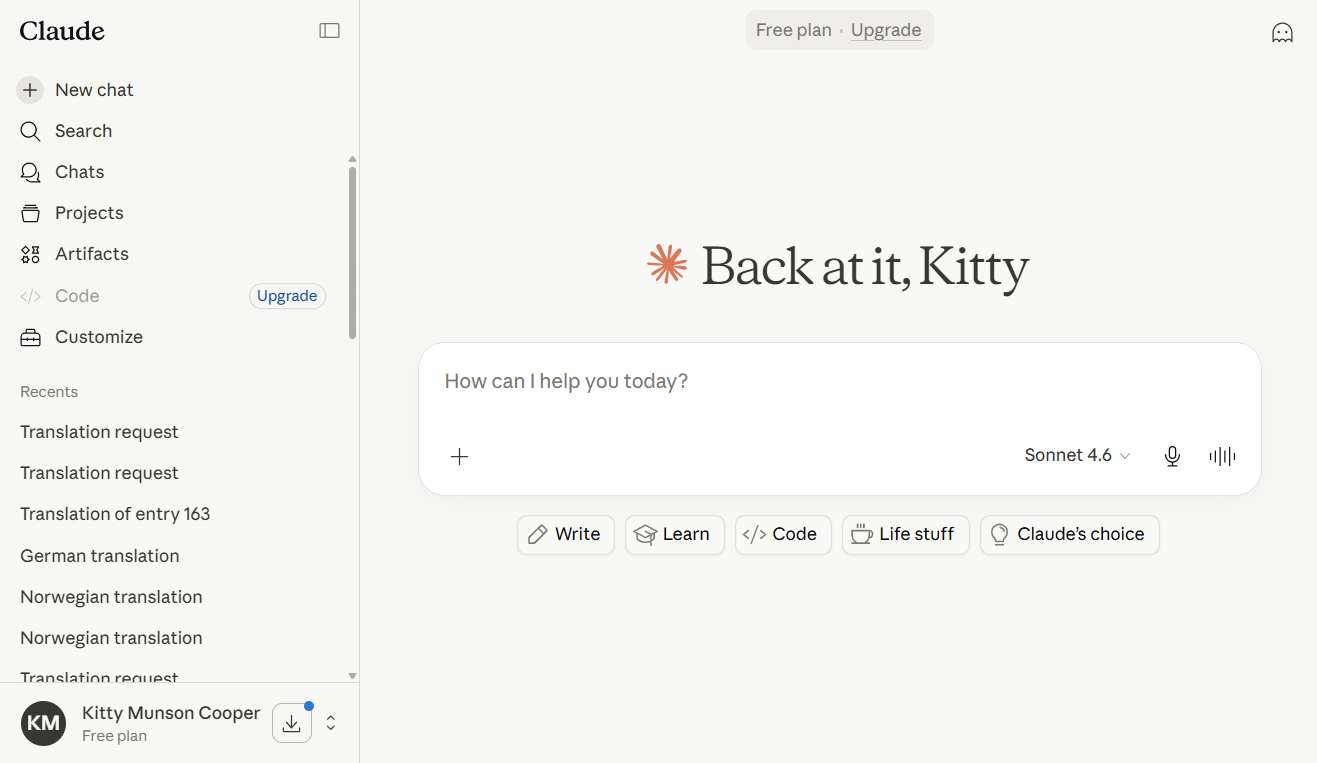
My home page at Claude

There is more than one free AI out there, so I ran an experiment. First I submitted a not great scan to all three of the better known ones, Claude, ChatGPT and Gemini. This is what I found:

  • Claude told me it was hard to read and only gave me a partial.
  • ChatGPT made stuff up that sounded totally plausible, but did not seem to be anything like the original Norwegian.
  • Gemini made an effort to translate it and did well, but organized it into bullet items.

So my new method is to upload the same document to Claude and Gemini and merge the result. One thing I like about both of them is that they remember my recent efforts in the left hand sidebars (on Gemini ask for the sidebar in settings). So far I have not used either one heavily enough to be asked to upgrade to a paid version, unlike ChatGPT which has already requested that.

Next I tried some handwritten German documents. In my opinion Gemini did the best job. Read on for how each AI performed.

Continue reading

Working with the Norwegian Farmbooks and AI

My past process to get a translation of what a Norwegian farm book says about my ancestors and their farm was somewhat laborious. First I made a good scan of the page, then I used a Norwegian OCR program to get the text extracted, and finally I asked google to translate that resulting text. Often the result sounded stilted and certain words did not translate correctly, like farm (“pa”) would be garden. Click here for my past post about that process. 

Today I tried Claude AI on a few not so great photos of pages from my copy of the Etne-soga farmbooks for a distant relative and wow, just wow. Not only was the process much easier, just upload a photo, but the translation was way better and more informative.

Here is an excerpt from my exchange with Claude AI:

Green text is added to this exchange with Claude AI


When you click the down arrow it even explains the Norwegian abbreviations! This is what it told me.

Notes:

“f.” = født (born), “d.” = død (died)
“bygsla” = leased/rented farmland (a common tenure arrangement in old Norway)
“lensmannen” = the local bailiff/sheriff
“rdlr.” = riksdaler, the currency of the time
“Lausøyret” = movable personal property/chattels
“leiglending” = a tenant farmer who leased land rather than owning it

The text cuts off at the bottom of page 573 — there is more to the entry on the following page.

I am amazed that Claude knew what the document was (a Norwegian genealogical record) and could give me information like that about common abbreviations and words. Previously Google translate had used “built” for “bygsla” as well as other slight inaccuracies.

This was all free! I would be happy to pay a small subscription fee for such a terrific service.

I have also used Claude AI for handwritten German records. Some it did well. Others it found harder but it always told me why, discussing that horrible medieval German script.

AI is bringing in a wonderful new era for us family history researchers.

My Fastest Father Find Ever

Randi contacted me for help finding her unknown biological father. I advised her to test at Ancestry and get back in touch when her results were ready.

When they came in, it took only three hours to find Randi’s unknown biological dad! She had two second cousin level matches at Ancestry with good trees who did not match each other. That meant that the search would likely be easy, since all I had to do was find where those two trees intersected. Here is how I did that, step by step.

First I created a private searchable tree at Ancestry to use for this case. I started it with Randi and her mom. planning to make floating branches for related people by copying the relevant lines over from their trees.

The best DNA match on Randi’s unknown father’s side was Brad at 322 cM. So using ProTools, I sorted the matches Randi and he shared by his closest matches, as shown in the image below.

Clicking on the sort button brings up a box where you can select to sort by the match’s relationship

The idea was to find the common ancestor among those matches. This would be the line that Randi is related on. To do that, I should have looked at the best one with a tree, excluding close family, but I saw that there was one a bit further down the list, Bob, who had an unusual surname, call it Roper, that was the same as one of Brad’s great grandmothers. So I built her tree back up a few generations and down again. I then copied Bob’s paternal ancestors over, looking for an intersection. I did not find one, so I moved on. Later Brad told me that the error was two women with the same name and birth year incorrectly in various trees, including his.

So I went back to the common match list and found the best match to Brad with a tree (Peggy). One of her grandmothers shared a surname, call it Whistler, with the husband of the Roper great grandmother. So I built the Whistler tree. Quickly found a common ancestor for Peggy and Brad with an unusual first name born in 1830. Built the tree of all his descendants. Somewhere in that tree will be our man.

Time to look at the other possible second cousin match, Jim, at 268 cM. The plan was to repeat the process of finding the common ancestor to his best match with a tree. However, his surname, call it Wander, had already showed up in the Whistler tree. Having collected all the descendants of Brad’s Whistler great grandparents, I noticed that one of them had married a Wander. Was that Wander in Jim’s tree? Yes, she was his aunt!

That Whistler-Wander couple, who must be Randi’s ancestors, had two children, a boy and a girl. The boy was the right age and in the right location. Could it really be this easy? Yes. The details of his life fit what was known. Since Randi’s presumed father is Jim’s first cousin, Jim is Randi’s first cousin once removed.

Continue reading