Archives

Reading Norwegian Churchbooks

My cousin Dick Larkin has put together a wonderful guide to reading Norwegian churchbooks which is now available in our downloads section. It includes many charts, urls, and images of handwriting. Since so many Norwegian records are online at http://arkivverket.no/eng/content/view/full/629 – this is great help in doing genealogical research. While the census records there are transcribed to typewritten entries and easy to use, the church records require pouring through the images of handwritten entries so help or skill is needed to interpret them.

Here are a few excerpts from his guide:

“If you have chosen your parents wisely, your genealogical research will include Norwegian records.  Norway has one of the most readily accessible bodies of genealogical data of any country outside the United States; the ‘Kirkeboker’, or churchbooks, are an important part of those data.  They are the primary repository of data on births, marriages, and deaths for roughly the period 1670 to 1930, and, best of all, they are online and accessible without cost. Their only real downside is that they can be a challenge to read. This paper will help you overcome that challenge.

and how to figure out which churchbook:
“There are three ways to start: – First and best is to scour your own family records, certificates, Bibles, letters, diaries, and the like, and to inquire of elderly living relatives for clues as to where in Norway your ancestors came from. – Second is to look on Rootsweb (www.rootsweb.ancestry.com) to see if someone else has been researching your family and has posted their family tree data there. – Third is to use theFamilySearch website, but this may or may not be very helpful without at least some other clues. For example, this search lists over 137,000 people named Ole Olsen born in Norway between 1650 and 1930. Two ways to narrow this search are first by date of birth (or other known or closely estimated date); second is by location – at least at the county level. But even narrowing the search to Vest Agder County, and birth years 1800 to 1830 still gives 692 Ole Olsens. Death records in the United States sometimes identify a birth location in Norway; a farm name may give a clue (but a given farm name will likely be found in multiple communities and counties).
 [Editor’s note  when your ancestors names do not end in -sen or -son they have probably taken their farm name as their surname in this country for example Sande, Hauge, Skjold, and Tveit are all farm names. The familysearch listings for specific counties usually give a list of farm names but these may not be complete so try googling for the farm name with the words farm and norway. For example, googling for “tveit farm norway” turns up farms in at least four different counties.]

Continue reading

We have results from a first cousin

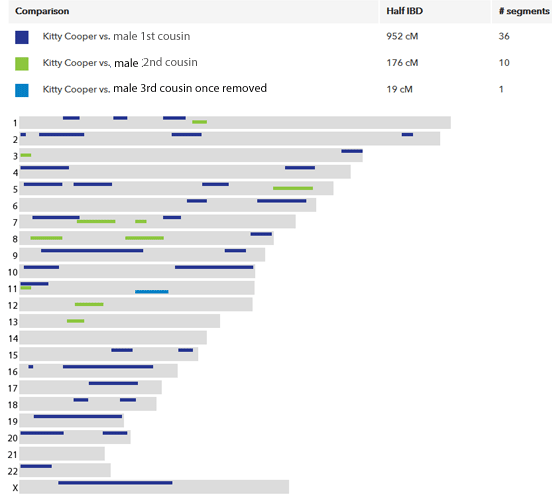
One of my cousins (half Norwegian) on Dad’s side (all Norwegian) just got his results. So I made this chart comparing myself to my 1st, 2nd, and 3rd cousins on Dad’s side. Mind you, the 2nd cousin is on Dad’s paternal side while the third cousin is on his mom’s side.

Kitty's DNA versus her cousins

Kitty’s DNA versus her cousins

My brother’s chart looks very similar except no X match of course. Notice the very large X match I have with my first cousin which would come from his mother and my Dad’s mother, 57.3 cM. Interesting to see this as compared to my Dad ….

Continue reading

It’s a Match!! Lars Monsen’s ancestors are found.

The direct male line descendant of Ole Monsen Titland  (1702-1764) is a Y-chromosome DNA 34/37 match to my Dad, who we thought was also a descendant of Ole. Now we know he is!

Thank you so much cousin Sigmund for finding a distant cousin in direct paternal descent to test.

This story was written up a few months back in a post here but we were waiting on the DNA Y-chromosome STR test to prove our theory. Now it is proven.

Here are the deeper details of the three markers that do not match:

Continue reading

We have found our ancestor Lars Monsen!

Due to DNA testing, in a round about way, we have probably solved the brick wall of our ancestor Lars Monsen who was born in the Bergen area and lived in Kristiansand, Norway. His great-grandson Lauritz (later Lawrence Josiah Munson), my grandfather, came to Brooklyn, NY, with his family when he was six. That story is posted on this page about the Monsens at my family history site.

Lars Monsen had been our brick wall for a long time since it is a common name in the Bergen area although not, we thought, in southern Norway. Well it turns out there really were two men named Lars Monsen in Kristiansand at that time. One was Lars Monsen Suldahl (thus from Suldahl) and ours was Lars Monsen or Mognsen Aastvedt from Eidsvaag (just north of Bergen)

Here is the story. Dad’s Y DNA matched almost 6000 people at 12 markers on the family tree DNA site. So I used the Ysearch site to look for only Bergen area matches. I contacted those two people and heard back from one. Next we both upgraded to 37 markers to see if we still matched. In the meantime our match, Sigmund, posted some queries in the best Norwegian forums for Bergen and Kristiansand areas and the local historian/genealogy experts weighed in and found a likely candidate for our Lars. Sigmund now found us a male line descendant from Lar’s grandad and sent him a Y DNA test kit! [UPDATE: they matched, see http://blog.kittycooper.com/2013/05/its-a-match-lars-monsens-ancestors-are-found/ }

Continue reading

Norwegian Naming Practices and Genealogical Resources

So as I find more and more DNA matches with Norwegian-American relatives who tell me “Oh we have an Andressen or a Larsen too,” how do I explain what little use that is? I try saying, “Well in Norway before the late 1800s most people used their father’s name (so Jonsen means the son of Jon) and perhaps their farm name for a surname. So please tell me what locality your family was from and the farm name if you know it.”  Plus Per might be Peder in a different document and other names have other variations. Still one can’t complain, there are an enormous number of  Norwegian records online and the records go back to at least the 1500s in most localities.

I have found two resources which explain the naming practices quite well:

John Føllesdal also has an excellent website hosted by ancestry.com explaining how to research your ancestors in Norway.

Continue reading