Ancestry just did its yearly update to how it categorizes your biological ancestry by adding over 150 new regions. Many areas like Ireland, Scotland, Central Europe, indigenous America, Asia, and Africa have more detailed subgroups than before and I noticed two new countries in Europe: Belgium and Switzerland.
Ancestry uses both its reference panels and the many family trees it has to make those determinations. Plus for some of us, they have added a break-out by grandparent, that will be discussed in my next blog. My post on last year’s updates (click here) summarized much of the information in their white papers about how they do this. Notice that they include places that have been settled by Europeans, for example Madeira and Arcadia, where people have been there long enough to become a distinct group genetically.
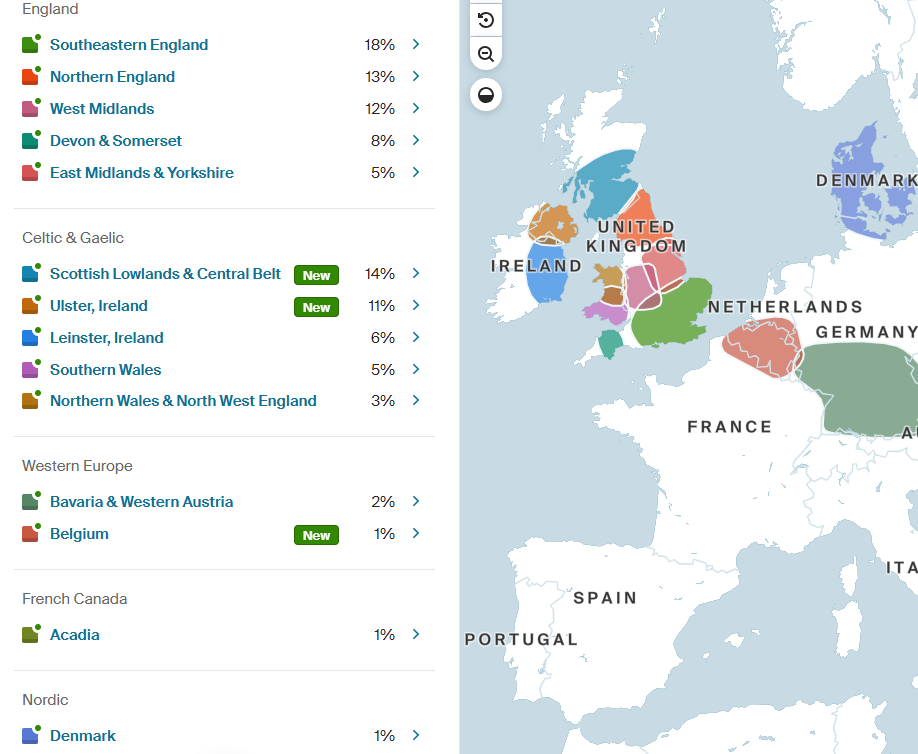
Sample Tennessean with deep colonial roots
Since I have helped many people with their results, I can see how their predictions have changed over time. Any regions that are newly being reported have a big green NEW label next to them. I highly recommend scrolling to the bottom of the list of regions and clicking on “View previous results and FAQs” in order to see what has changed for you.
Many people have seen a simplification of their results where some of the unusual 1% and 2% categories have disappeared. This is particularly evident in those who are European Jewish who now show only one or two totally jewish groups and no longer the oddball 1% this or that. My own results now correctly show 50% Norwegian from my Dad who was 100% Norwegian American. I knew I could not have 1% Irish which showed up in 2025, but I was confident of my 1% Finnish because other companies find that as well. Perhaps I am suffering from confirmation bias.
Here are my current results which have added some interesting new areas from my Bavarian grandmother:
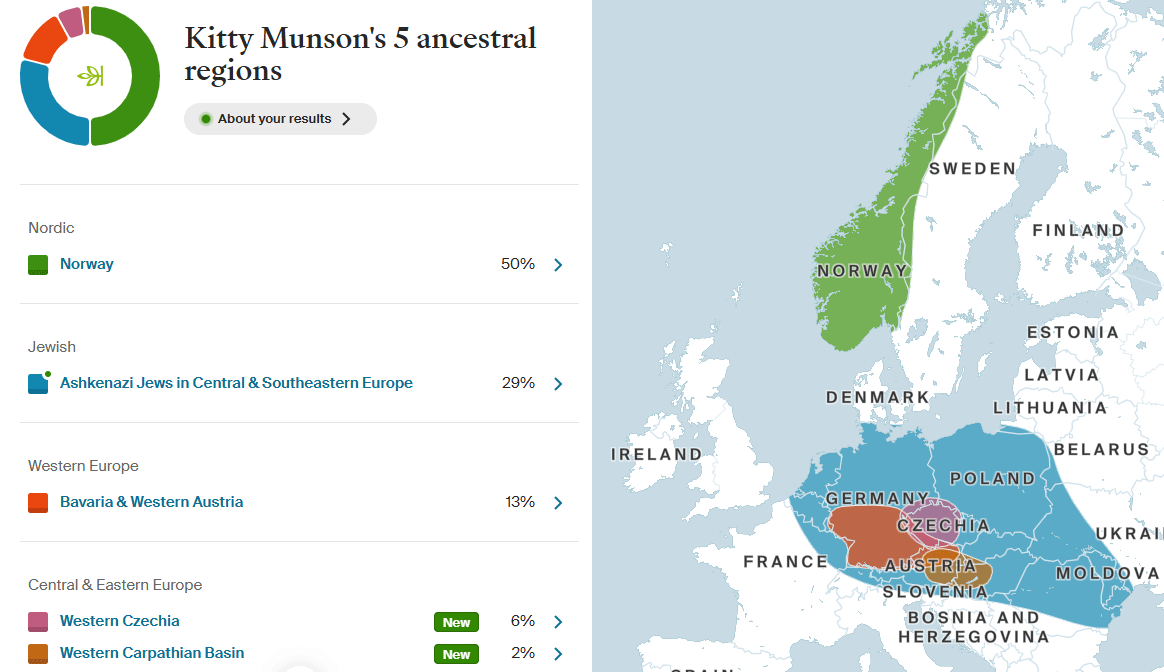
I have a second cousin who was 100% Scandinavian in the first Ancestry Origins so I called her my “perfect” cousin and featured her in many past posts on this subject. She is now 98% Norwegian and 2% Swedish having lost her 1% Finnish, like me, plus her swedish is now smaller.
There are many new areas in Africa, Asia, and Indigenous America. The full list of 126 regions can be seen in the white paper (click here) on pages 7 and 8. If you click on an region name in your list, you will be taken to a description of that locale and its peoples’ history plus there will usually be three matches listed which share that region. If you have a lot of close family who have tested, those matches will not be useful. It would be great if you could filter your main match list by these ancestry composition areas.
Let’s look at some of the more interesting results:
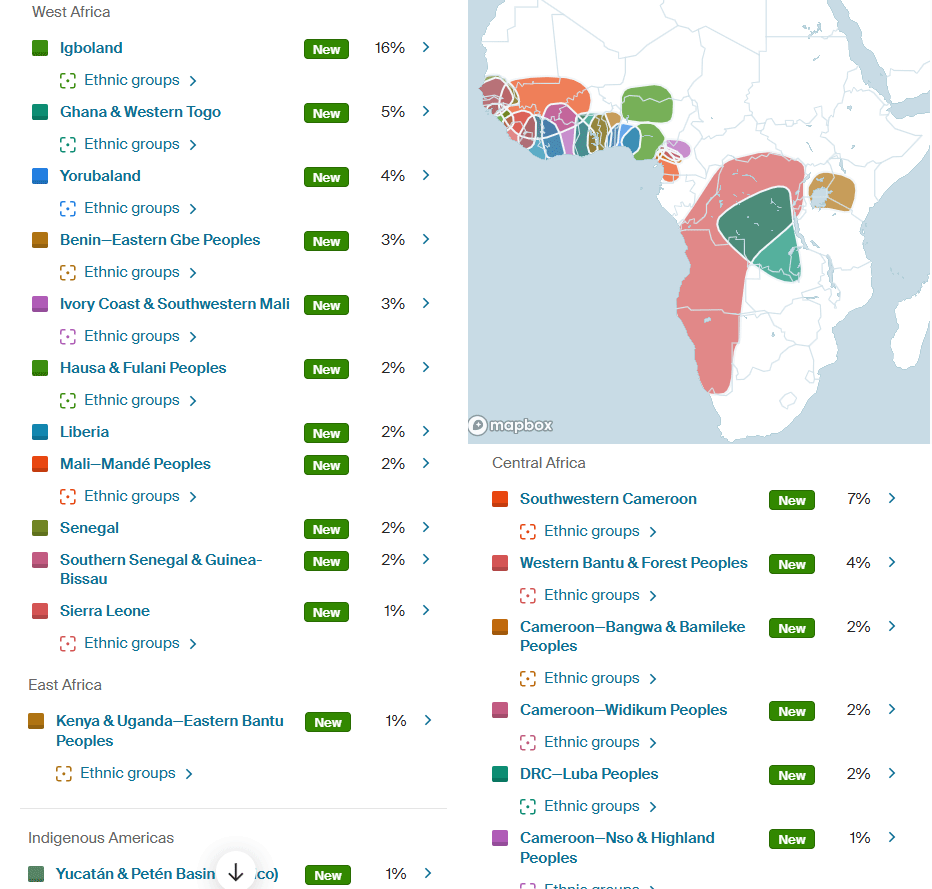
These are the results of a mixed race person, mainly African American. I have cut and pasted the image to just show the non European ancestry:
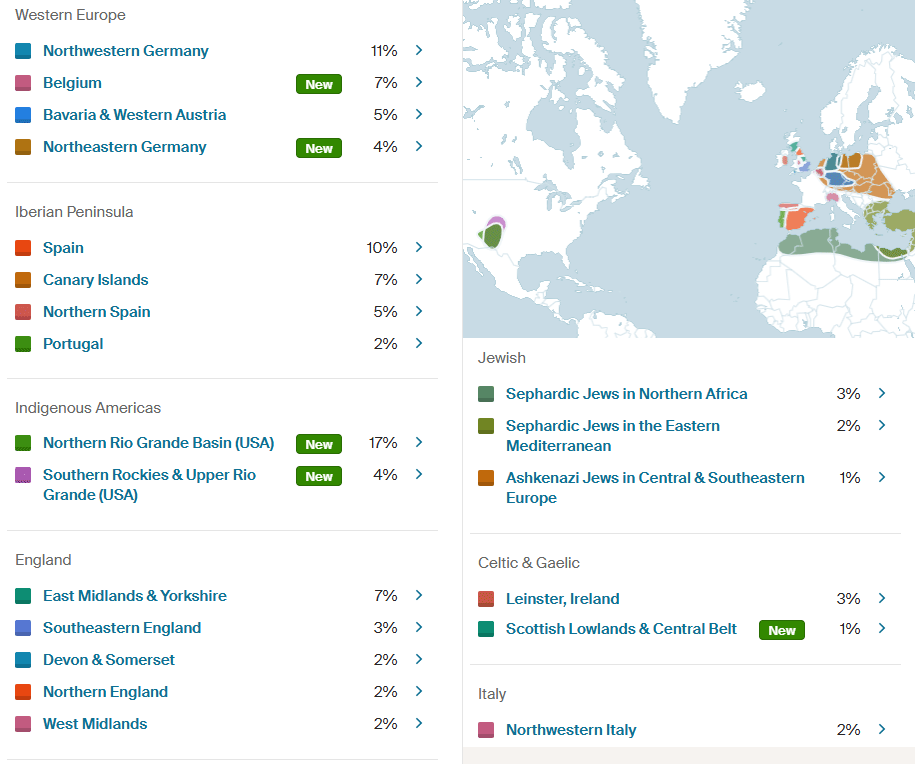
These are for a person with an American mother of Northern European ancestry and an unknown Dad who turned out to be Hispanic from New Mexico:
There are so many interesting new regions. Have fun learning about them in your own results!