Archives

Lets All Help Collect DNA Statistics

The DNA relationship statistics listed at ISOGG are invaluable for figuring out how you are related to new DNA relatives. This diagram shown there is a big help too:

DNA relatedness cousin tree courtesy Dimario, Wikimedia Commons

DNA relatedness cousin tree courtesy Dimario, Wikimedia Commons

More statistics would be even better so I am delighted to make the following request.

Genetic genealogicist Blaine Bettinger has decided to collect cM numbers for known close relationships from all of us who have tested. Read about it on his blog and then contribute yours. He wants family statistics out to 3rd cousins.

Blaine explains how easy to provide those numbers if you are tested at Family Tree DNA, but 23andme includes the X in their totals which skews the results. Plus they include segments smaller than 7cM which is not what Blaine wants. So I decided to make a step-by-step how-to for 23andme statistics collection.

Better is if your 23andme or Ancestry.com tested family members are all uploaded to GEDmatch.com. Then you can easily get the statistics there. Just run the one-to-many with the normal default of 7cM for each family kit and look in the columns Total cM and largest cM under Autosomal.

Continue reading

I will be interviewed on a Genealogy Radio Show

Photo of Scott Fisher

Scott Fisher, photo used by permission

Scott Fisher of Extreme Genes, America’s Family History Radio Show, will be interviewing me about genetic genealogy this week for his Radio Show to be aired next monday. Not sure how soon it will appear in the Extreme Genes archives, presumably sometime after the broadcast. The show is carried by 27 stations so check yours.

There are lots of interesting podcasts in those archives! Wondering if any of you already knew about this show and are regular listeners.

I will post more information here when I have it.

Triangulation: Proving a Common Ancestor

The same question seems to come up over and over again among those new to autosomal DNA testing. If I match A and B on the same segment why is that not enough to prove they match each other and we have a common ancestor?

The reason the ancestor is not proven is that you have two strands of DNA on each chromosome (remember there are 23 pairs of chromosomes) and the testing mechanism cannot differentiate between the two of them. So A could match the piece from your mother and B could match the piece from your father or one of them could even be a false match to a mix of alleles from both parents (see my post on IBC for more on that concept)

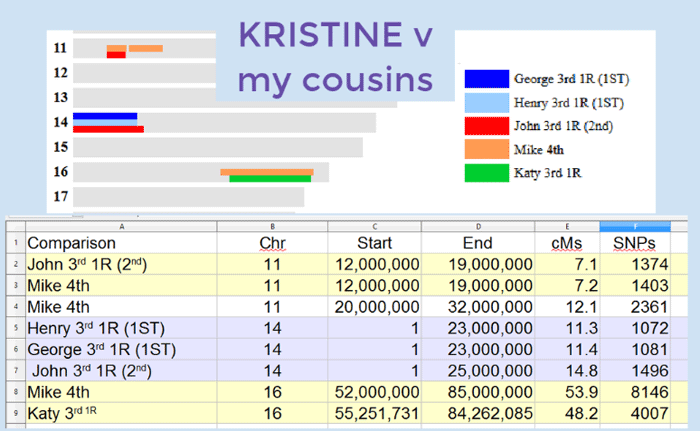
The way to prove the common ancestor is to see if A and B match each other in the same place that they match you. This is what we call triangulation.

Triangulation example

Kristine’s shared DNA with other Wold descendants, relationships are to her (to me in parenthesis)

About a year ago I blogged about how, after many years, a change in spelling on the paper trail had led fellow genealogist Dennis to think his wife Kristine was perhaps descended from my great-grandmother’s brother Carl. To prove this I suggested he test her autosomal DNA.
Continue reading

Rootstech 2015 is next week! Come to my talk

Next week is Rootstech 2015! I can’t wait. I had such a great time last year. I met many of my facebook friends, fellow genetic genealogists, and genealogy bloggers in person and got to enjoy their talks.

OneWorld,OneTreeI am pleased that this year I will be giving a talk, about the advantages of contributing your research to a one world tree. I will also compare the features of the big three, FamilySearch, GENI, and WIKItree. A topic that I blogged about last year.

Rootstech has a cool app for your Ipad, Iphone or Android which will track your schedule, your friends, and more. You can get it from the app or play store, just search for Rootstech 2015.

Continue reading

DNA testing finds some more Skjold cousins

Hans Martin Gunderson

Hans Martin Gunderson

The randomness of DNA inheritance always amazes me. My Norwegian-American father seems to have inherited more DNA from his Skjold grandad, “Dada,” than his Wold grandma, “Mormor.” Dad shares more than the expected amount of DNA with 3rd and 4th and double 4th cousins on his Skjold line. Of course this could also be explained by the slight endogamy in the area they come from, Etne, Hordaland. By comparison, Dad shares no DNA with a Wold 3rd cousin once removed and only a small amount with her mother. He shares more with a few other Wold cousins but it tends to be less than the expected amount with the more distant cousins on that line.

Recently I found two new Skjold cousins via DNA testing, Maria and Irene.

On Ancestry.com, a 3rd cousin match appeared for my brother which turned out to be a real 3rd cousin, a Gundersen relative who is descended from Dada’s sister Margareta. Her son who immigrated to Brooklyn, Hans Martin Gundersen, is pictured on the left.

On 23andme.com, I found a new 3rd-4th cousin on Dad’s list, who was found to be from another branch of our Holland relatives. The Hollands descend from Dada’s Aunt Mette (see my post with her portrait). My father’s newly found 3rd cousin twice removed shares 1.10% of her DNA with him: 4 segments totaling 84cM. This is on the high side, more like a second cousin once removed (click here for the article at ISOGG about the expected amounts of shared DNA).

So read on for the details of how I figured out the actual relationships with my new cousins.

Continue reading