Archive by Author | Kitty

Half sibling or Nibling? A first look at the 25% relationship data

A question I often get is “Can you tell if this DNA match is my uncle or my half-brother?”  Why this question? Because it is very difficult to tell the difference between a half sibling and a nibling (an aunt/uncle/niece/nephew) relationship from the amount of matching DNA. Like grandparents, they all share 25% with you, or about 1750 centimorgans (cMs) give or take several hundred. Unlike grandparents, the age difference can’t usually be used to tell them apart. The testing companies might call him “close family”, “first cousin,” “uncle,” or the more descriptive “1st Cousin, Half Siblings, Grandparent/ Grandchild, Aunt/ Niece” from Family Tree DNA, which by the way is my Dad’s actual great-niece’s designation. Then they show you the amount of shared DNA in centimorgans and maybe a percentage, but really they are just making an educated guess about the relationship.

I wanted to find a way to help adoptees figure out more accurately which relationship a new 25% match was likely to be, so I collected detailed statistics using a google form for about a year, getting some 2400 responses. These were self-reported from people who read my blog or are members of groups on Facebook where I publicized this. I am still collecting, so feel free to add yours to my form (click here) to get included in the next report. GEDmatch numbers preferred.

My experience from helping people understand their DNA results had led me to suspect that segment sizes were the key to telling these relationships apart. I had noticed that the sizes of the four largest segments would usually be much much larger for half siblings than niblings. However now that I have these crowd-sourced numbers, I can see that much of my personal experience came from helping with paternal side cases. There the segments are consistently much larger.

Can you tell a nibling from a half sib by the shared number of segments and centimorgans?

The collected wisdom of the many adoption search angels is that the number of segments can indicate the difference. While this usually works for nibling versus grandparent, half siblings too often seem to fall in the range of one or the other.

The DNA adoption folk have a chart which shows the number of segments expected for each relationship (click here for that PDF) which is very useful, just not enough for determining half siblings. They carefully separate the AncestryDNA results which can have more segments and fewer total centimorgans due to the removal of some matching data deemed less significant. DNA adoption also has an automated relationship estimater based on that data.

Leah Larkin recently wrote a fascinating post – Escape from the Overlap Zone – which showed simulations for these relationships which indicate that grandparents can easily be told from niblings since they have far fewer total segments. However again, the simulations show that half sibs and niblings have considerable overlap.

So how does the collected data compare?

Here is a scatter diagram graphing total centimorgans (X axis) versus number of segments (Y axis) for just grandparent and nibling relationships. This used only the GEDmatch data for consistency. The niblings are the lavender color and the dark results show where they overlap with the beige-pink colored grandparents. This is not far different from the predictions although there is more overlap than expected but look what happens when I add the half-sibling data below right.

The graph is hard to read now since those results overlap both categories. The colors are semi-transparent so the darker areas are created by having multiple colors in that area. There seems to be considerably more overlap than the simulations predicted.

It looks like just using just shared centimorgans and number of segments will not produce a clear answer as to whether a 25% relationship is a half sibling.

Notice the funny shape of the half sibling blues. There is a bunch on top with the niblings and another group with the grandparents. Fortunately someone had suggested that I include a question asking which side a relationship is on, paternal or maternal.
Continue reading

An unusual relationship shown in DNA

Sometimes DNA can reveal an ugly truth. A reader, let’s call her Patty, asked me for help explaining the unusual looking comparison of her DNA test results with her uncle Bob’s results. The surprising thing was the large number of green bars that she saw in the GEDmatch one to one comparison, indicating fully identical segments (FIRs), almost as many as a full sibling would have. How could that be?

Of course my first thought was that Bob is actually her full brother, that her mom, Janet, had a child out of wedlock who was raised by the child’s grandparents, Mona and Dick, as their son. This has happened in many a family. But that was not the backstory. Janet was a small child when her brother Bob was born. Bob and Patty also share just one segment of 27 cM on the X chromosome, which, of course, would be normal for a maternal uncle but low for a brother. Have a look at the comparison image from GEDmatch for chromosomes 1-22:

image of the 22 chromosomes

Thoughts? Usually only full siblings or double first cousins will have numerous fully identical segments, so what could this be? Obviously Patty’s dad would also have to be a close relative of Bob’s for there to be so many FIRs. A full sibling would usually show even more of them, however.

Continue reading

Summer Sales on DNA kits

Personal DNA test kits are only $69 in the summer sales at three of the major vendors: Ancestry.com, Family Tree DNA, and MyHeritage. So which one to do? Well that depends on your objectives. If you are testing for the fun of it, then maybe Ancestry with the largest database and automatic tree matching is the one for you. I have lots of details on why to pick one or another in my page of DNA test comparisons.

Family Tree DNA Friends & Family Sale - Family Finder Only $69But beware, if there are any family secrets such as your dad or grandad not being whom you expect or an out of wedlock child, DNA will out them. Recently an amazing story where DNA revealed a surprise was reported in the Washington Post. The tester’s Dad was switched at birth in the hospital!

Another warning is that the science of figuring out where your ancestors are from via DNA is still in its infancy. They really cannot tell the difference very well between German or Scottish ancestry, both can look Scandinavian or English, click here to read my blog post on that topic. They do fine with broad continental predictions. Also some ancestry is very distinctive, so easy to predict, like Finnish or Ashkenazi or Subsaharan African. However Native American may show as East Asian and gypsy might be South Asian.

If your ancestors are recently from Europe then you might have better luck finding cousins at one of the other companies besides Ancestry. Very few Germans in Germany have tested and those few are mainly at Family Tree DNA. Of course you can upload your autosomal DNA results from the other companies to Family Tree DNA.

If your ancestry is from the British Isles you might consider testing at Living DNA currently on sale for $119. This gives a detailed county by county break down in Britain of your ancestry and seems fairly accurate. Plus they are also making a push to get Germans to test.

Continue reading

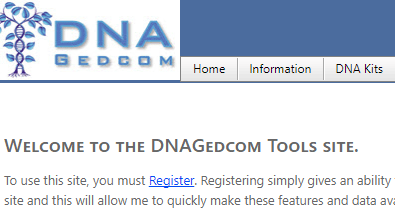
DNAgedcom can compare gedcoms and help analyze match results

The DNAgedcom site was created to provide tools for adoptees using DNA to search for biological family but it is also very useful for those of us working on our family’s genealogy. Down with those brick walls!


Richard Weiss of DNAadoption.com did a very informative talk for our local genealogy group recently and as always, I learned a few things. Click here for that presentation which I uploaded to slides.com for him. In the next few weeks there will be a voice over version on DNAgedcom; I will add that link at the bottom of this article when it is ready.

There are two terrific free web sites created by volunteers that have tools to use with your test results that are often confused with each other: GEDmatch and DNAgedcom:


  • GEDmatch is a place to upload your DNA results and GEDcoms and compare those to possible cousins and your family. Click here for my many posts on that wonderful site.
  • DNAgedcom; is a place to upload your match comparison results, not the DNA results, and work many tools on them. You can even upload your match results from GEDmatch!

The key to successful use of DNAgedcom is to get a paid membership for at least a month and download their client program, DNA Gedcom Client (DGC), to collect data from the sites where you tested.

The feature that I have used the most as a genealogist is the collection of all the segments that every person I share with at 23andme.com shares with each other. Of course now that there is automated triangulation at 23andme, this is less important. Click for a good article at segmentology on that 23andme feature and also click here for this article of mine about the new 23andme experience which discusses it towards the end.

There are two main types of analyses you can do at DNAgedcom:

  1. Tree comparisons
  2. Segment data analysis

DGC can collect the tree data from Ancestry.com with ease. I use the fast version, 4th cousins only for most cases and then follow with Gworks for the analysis. If you are lucky, you may never need to look at segment data at all to solve your mystery.

Continue reading

Using Ancestry DNA hints to prove and disprove ancestors

With over 4 million DNA tests [as of 11 aug 2018 – 10 million], the Ancestry database has reached a tipping point where any tester with American ancestry will get some good cousin matches. How do these help prove an ancestral line? Well when your DNA matches multiple people descended from the same ancestral line, you can have some confidence in that part of your tree. Conversely, if you have no matches on a line, there may be a problem.

On your DNA home page, the center panel summarizes your match count. It shows the number of predicted 4th cousins or closer as well as the number of starred and green leaf ancestors. You can add stars to matches for whatever reason you wish. Only you and anyone you share your DNA results with can see them. Ancestry will indicate each DNA match that also has a tree match with you by using a green leaf.

Ancestry DNA Home Page Center Panels (words in red are mine)

Notice the big difference in the number of cousins between those with 19th and 20th century immigrant ancestors like my family and those with deep American ancestry. Also foreigners like my Norwegian cousin will have very few, while Jewish testers will have incredibly high numbers due to endogamy.

DNA Matches Page

Click on the green View All DNA Matches button to get to your DNA matches page. Or click on the starred or green leaf matches to see just those matches. On your match list page, every DNA match who also has a matching ancestor to you in their tree is marked with a green leaf indicating a hint.

When there is a green leaf, clicking on the View Match button will take you to a page that will show you a picture of the expected relationship pathway (images of that on page 2 of this article).

Many times matches with no tree will actually have a tree that is just not connected to their DNA. You can see that on the view match page. There you can select it in the dropdown menu, as shown below, to get the usual sideways display with a surname list. Sometimes you can even figure out where they fit in from it.

I like to make Ancestry do the work of checking my assumptions by adding the tentative line to the tree connected to the DNA test. I put a “??” as the suffix when I am trying out a set of ancestors so that anyone copying my tree is warned that it is a test. Strange characters in the suffix box do not seem to affect the matching. Another perhaps better solution is to make your tree private while you experiment. Or to use a second small private tree that you connect your results to when trying out a possible ancestral line. You can change what tree and who your DNA is connected to on the DNA settings page. Get there from the button with a gear on the top right of your DNA home page.

Here are some examples of my experiments.
Continue reading