Ancestry.com has just completed a major update to its DNA bio-ancestry predictions that has broken down European countries into many smaller areas. They have added 68 locales, mainly in Europe. French Canadians are no longer listed as France, now they are either Quebec or Acadia. They have also made four jewish groups from one: Central and Eastern Ashkenazi plus North African and East Mediterranean Sephardic. Almost all my Jewish friends have no Sephardic listed, giving the lie to some family stories. There are some interesting new categories like Germans in Russia and one combining both sides of the English Channel into a new category called Southeastern England & Northwestern Europe.
I am enjoying looking at the updated origins of many of the people I have helped. On the next page I will show images of the more interesting mixtures. Here is a classic North European mix of a Tenneseean with colonial roots.
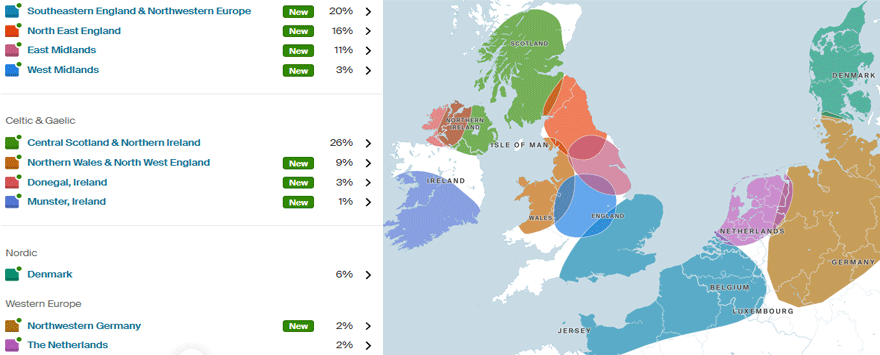
I do recommmend scrolling down and clicking on the link to what has changed. Below is the image of how the predictions for our Tennesseean are different from last year. Notice that Germany has gone from 21% to 2%. Some of that must now be Denmark and some SE England & NW Europe.
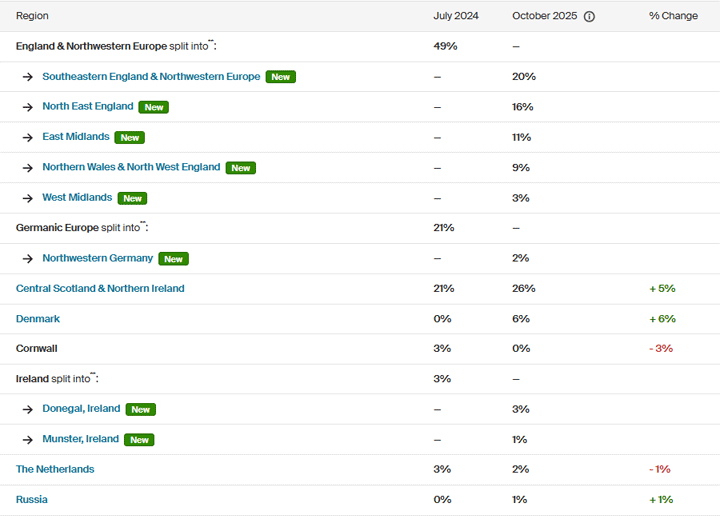
While 1-2% could be a 4th or 5th grandparent, it could also be just noise or too far back to find. I have often told people not to worry about a 1% call as it is too small to be sure of. In my own case, I lost my 1% Finnish, which I actually thought was accurate because its location matches one of the two where my Norwegian American dad has Finnish, according to 23andme. Additionally, 23andme has my brother matching the other location. We have yet to find that Finnish 4th or further back grandparent, but we do match many Finnish people on those segments over at GEDmatch. Perhaps they just have some Norwegian. More on that in another blog post.
To quote my own blog post from 2020 comparing the origin predictions at each company “predicting the ethnicity for people of Northern European heritage like my brother and myself, is very hard to do accurately because there was so much mixing of those populations.” The book “Who We Are and How We Got Here” by geneticist David Reich makes that point well and goes into the details of what ancient DNA teaches us about European migrations and mixtures.
I found the explanatory Ancestry white paper (click here to read it) hard to understand, so I enlisted two different AI platforms to summarize it for me. A fun use of this technology. To be fair, after the quite technical many paragraph summary ChatGPT gave me, I wised up and asked Claude to summarize it in plain English. That went better. Here are a few take aways:
Scroll down to move on to the origin images if you prefer not to slog through these explanations.
From ChatGPT after many many good but highly technical paragraphs:
Take‑Home Points
- AncestryDNA’s 2025 release markedly increases the granularity (146 regions) and refines the inference algorithm to improve accuracy.
- The method combines phasing, haplotype modeling, and a Hidden Markov Model to assign bits of each person’s genome to ancestral regions.
- The reference panels are carefully constructed from a mix of customer data and public datasets, with rigorous filtering to avoid admixture noise.
- Validation indicates generally strong performance, especially for reasonably large assignments (above 5 %), though precision varies across regions.
- The white paper is transparent about uncertainty, limitations, and the ongoing nature of improvement.
Now an excerpt from Claude‘s plain English summary:
The Basic Idea
Your DNA is like a patchwork quilt made up of pieces from different ancestral populations. AncestryDNA compares your DNA to reference groups of people whose ancestors have lived in specific places for many generations. By finding which reference groups you match best, they can estimate what percentage of your ancestry comes from different regions.
[… stuff removed …]How Accurate Is It?
They test their model using several approaches:
- Simulated data: Creating fake DNA profiles from known ancestral combinations and seeing if their algorithm gets it right
- Single-origin individuals: Testing on people known to be from one place
- Family tree validation: Checking results against people who have all grandparents from the same country
Generally, their accuracy is quite good; when they predict a region above 5%, they’re usually correct, though some neighboring regions can be harder to distinguish (like different parts of England or Ireland).
The Bottom Line
AncestryDNA’s approach combines massive amounts of customer DNA data, sophisticated algorithms, and careful validation to estimate where your ancestors came from. While not perfect, it’s generally accurate for major ancestral components, though it can struggle with distinguishing between genetically similar neighboring regions.
Before we look at the images of the updated origins of some of the more interesting ad-mixed people I have worked with, here is my own family.
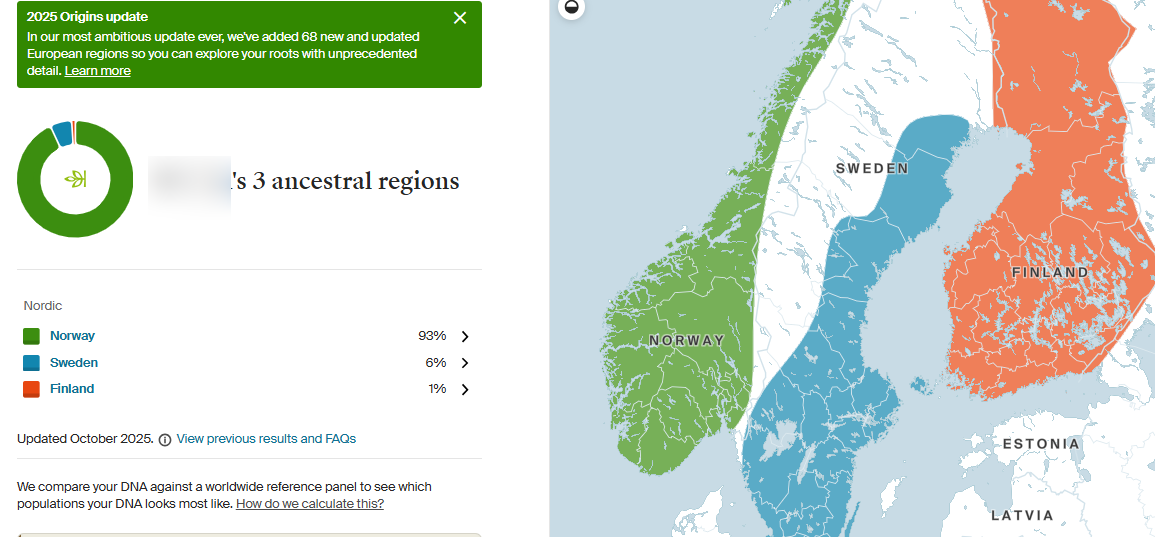
My Norwegian side is known to be from Southern Norway: Hordaland, the Agders, and the Drammen area. The journeys feature of Origins at Ancestry shows those details nicely, plus you can learn the history that surrounded and shaped your ancestors using the Timeline feature. There have been almost no changes to the Ancestry Composition of us Nordic peoples. Here is my perfect cousin who I featured in a past post as the only family member who got 100% Scandinavian
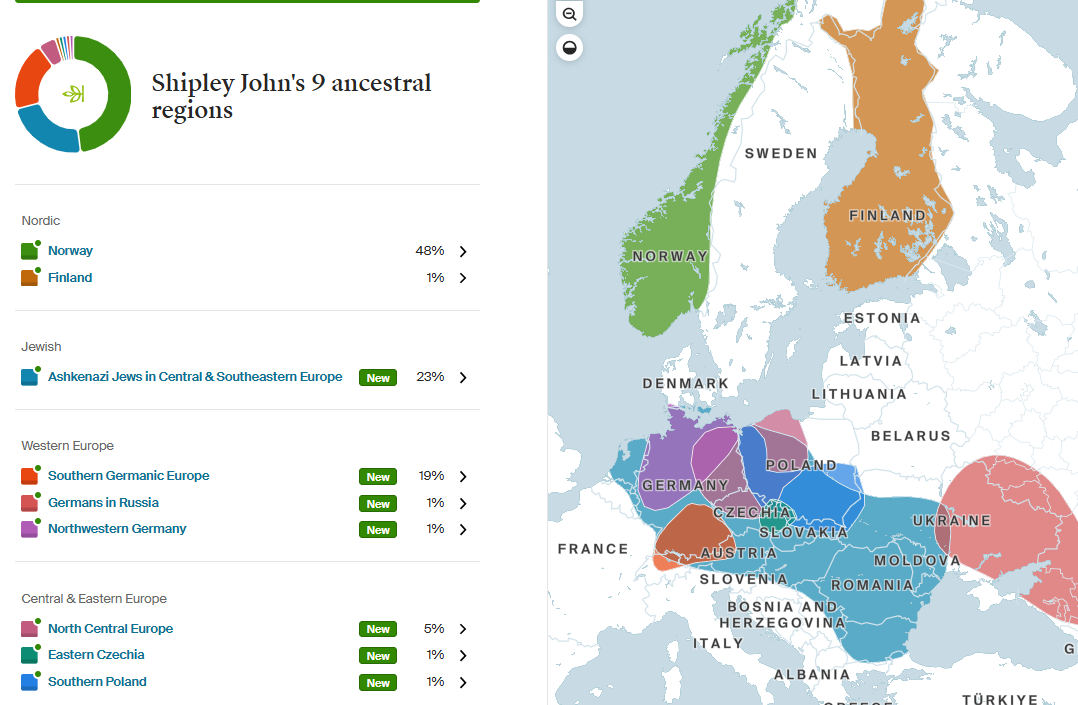
My German side is half Jewish and half Bavarian but appears to have a few roots further East. Here are my brother’s results. Notice that, unlike me, he has kept that tiny Finnish amount
Now for a few more unusual results:
Here are the regions for two unknown father cases where the mother’s origins were colonial American while in one case the father was Mexican and in the other case he was Hispanic with deep roots in New Mexico. Can you tell which is which? The answer is below both images.
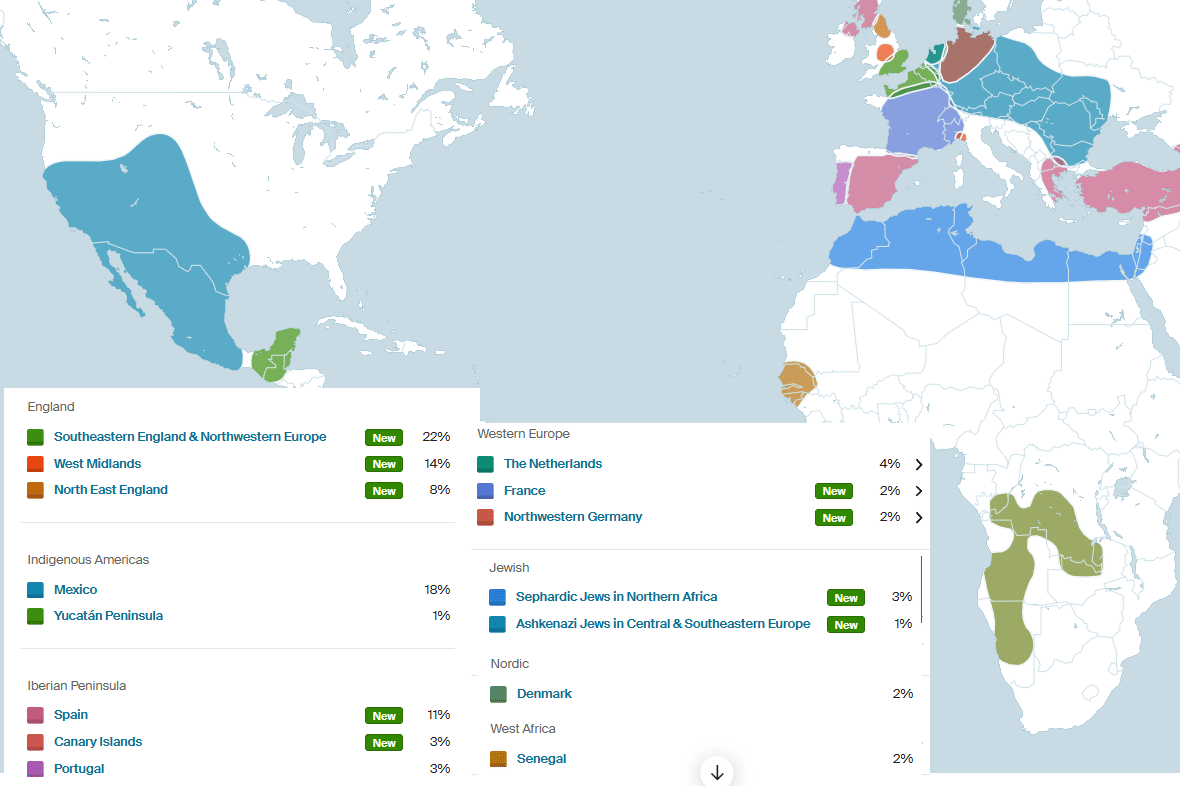
Origins of unknown father 2, (yes I edited this so easier to read by moving the text)
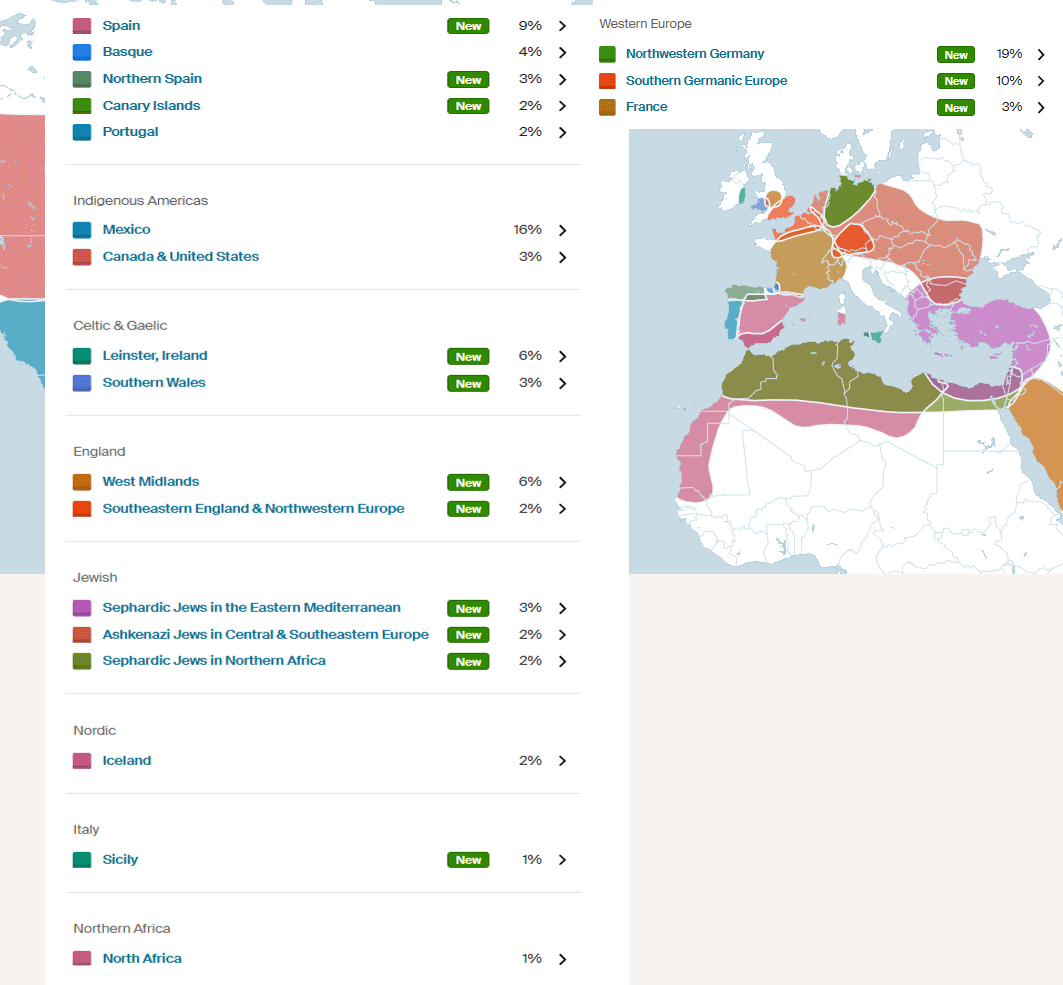
Origins of unknown father 2, (yes I edited this so easier to read by moving the breakdown over the Americas)
One thing to notice is that they both have a sprinkling of Jewish. That is because many jews “converted” and then emigrated to the New World where they often continued to practice their faith in secret. Click here for the wikipedia article about that. They both have Spanish, Portuguese, Canary Islands, and indigenous American.
Number 1 is Mexican. They are very similar. Typically New Mexican will have more Jewish and no African plus some American indigenous. Both will have Mexican indigenous although Mexican may have more plus some Yucatan.
Here are a few more fun ones; both cases are unknown fathers with mothers of primarily British Isles origin. See if you have any thoughts about this one. Click here for the blog post which ends with her unknown father search.
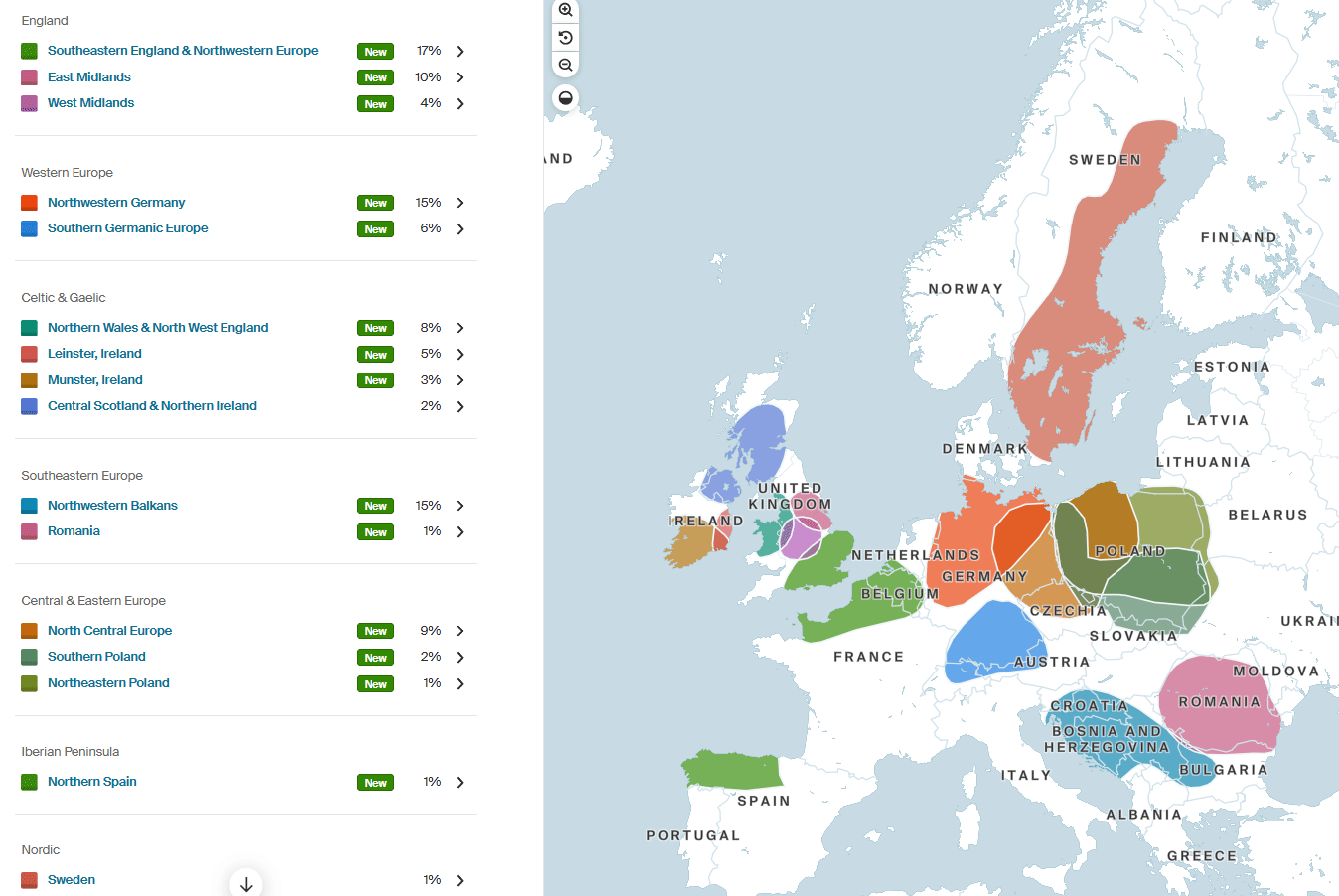
Thoughts on this next one? Click here for the blog post about her unknown father search.
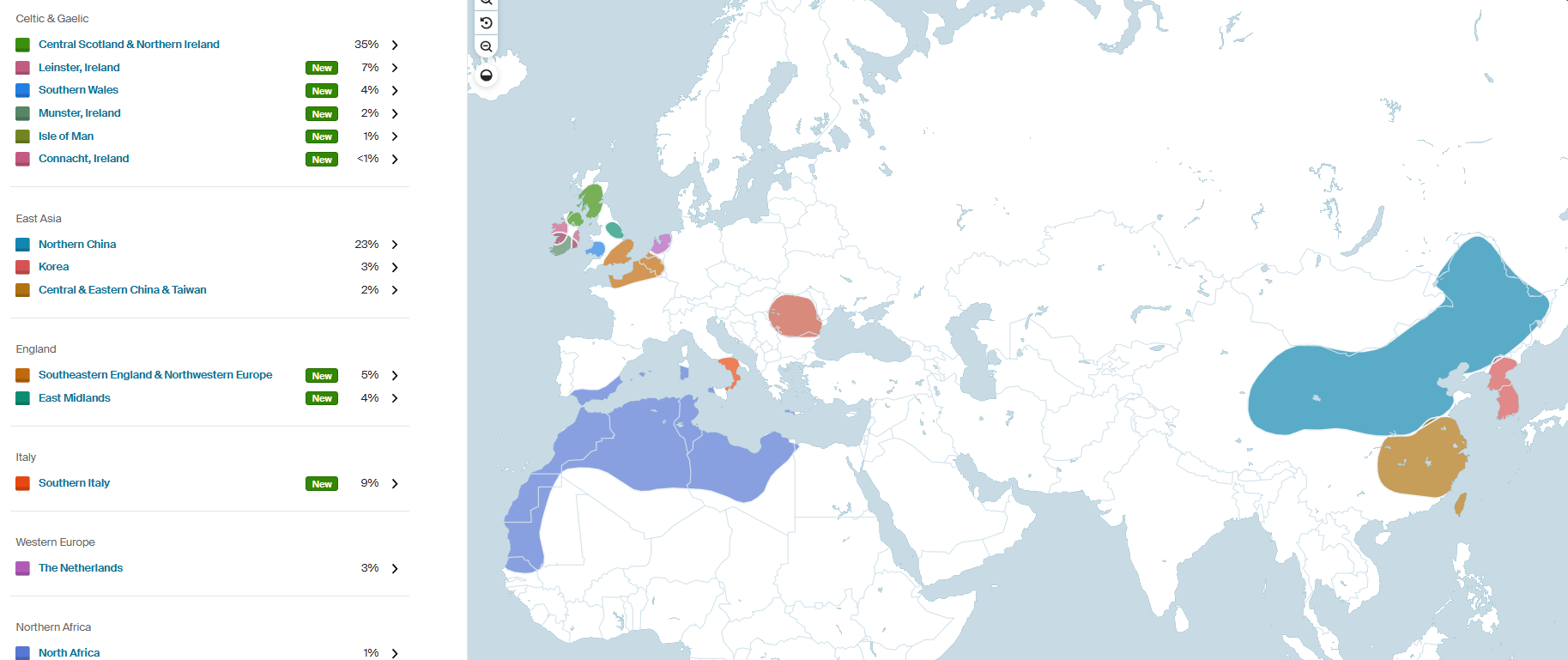
Have fun expoloring the new bio-ancestry estimates at Ancestry. Well this has been a much longer post than usual. Please note that many of the tools mentioned in the posts for these cases are no longer available. However the sheer number of DNA testers make these searches very possible without special tools. I wonder how soon AI can be harnessed for that task?
Ancestry’s ethnicity estimates appear to be getting more accurate over time. I do take issue with their assertion that having certain matches means ancestry rather than simply relationship, though. For instance, this latest report says I have 2% Icelandic ancestry, when instead I really think it’s a matter of having ancestors in common with Icelanders. Because my father’s Y-DNA is I-m253 and paternal ancestors who likely lived in the Orkneys, that’s very likely, while my research has never even hinted at any migration from Iceland.
Yes that is quite likely. I now have 1% Irish Munster which is clearly incorrect; I did not even mention it in the post. Perhaps my Viking ancestors visited there… small percentages can be false or based on common ancestors as you suggest.
I also have 1% Irish Munster this time around, showing up on my maternal line. Interesting idea of it being Viking related, since I’m largely Danish on that line as well.
When DNA ethnicity predictions first began, they were just about which continent our people came from. They were fairly accurate but lacked any specific detail. Any recent increase in specificity is usually accompanied by a slight drop of accuracy – in our eyes. Usually, the next update afterwards refines the prediction and that particular region roughly maintains specificity and improves accuracy. And so the caterpillar slowly advances.
There are two continuing causes of inaccuracy that we need to understand.
1 Neighbours. One region can be similar to any of those adjacent, as you wrote.
2 Proxies. I have ethnicity that is known to have moved about 1000 years ago to two regions. The one that most labs test is roughly Croatia, so if I score ethnicity there it is a proxy to the place my people actually went – south east of Berlin.
Similarly, for a long time my Cornish were represented as coming from Scotland, Ireland, Wales, Brittany, Spain, because they were Celtic. Now most labs have a Cornish panel.
Most labs use panels drawn from people likely to have been in a certain area for a long time, so they try to be accurate. However, many people may think their grandparents were born in the same area, but they might be wrong. And these days, you are now talking about people whose grandparents might have moved as children in the re-organisations after the first world war!
My great great grandparents were born in Poland in 1810, but the Napoleonic Wars had moved people around too and wars a generation or two before and after did so too.
I don’t envy the labs trying to assemble properly representative panels.
It can’t be easy.
Pingback: Friday’s Family History Finds | Empty Branches on the Family Tree
Kitty, I would encourage you to compare your Ancestry ethnicity estimate with one provided by My Heritage. My most recent one with My Heritage breaks down what Ancestry calls Germanic into what is more accurate, Dutch. The Canadian Mennonite project has been able to pin point two Dutch villages as the home place for my Dad’s ancestors. It helps explain why three times in the Amsterdam airport I have been stopped and asked questions in Dutch.
William, I am glad MyHeritage’s ethnicity estimates are good for you. In the past they were far behind the other companies. My own estimates are not great but closer than in the past. My Bavarain grandmother’s contribution shows as German, Dutch, and Eastern European. No Dutch expected here.
Kitty, I am wondering if I can ask you some questions about a complicated DNA mess that is both autosomal and MT. I go so far and my brain gets fried. My MT DNA is rather rare H15a1b4 and I have two identical matches at FT and one is via a shared 5 times great grandma and the other is adopted. I have a third one that is one step away with a different haplotype, but many of us share dna with their listed female line. Sorry to sound dense. There is one hunk of autosomal dna on chr 11 that is showing multiple times with my Ogan family, but also with a McDonough family and then several other surname families. I mean, how far could NPEs go??? Bill
William,
An exact match of mtDNA is no guarantee of a recent common ancestor, although you have found one. More often those matches are too far back to find.
As to the autosomal, surnames don’t help on the female line. Also don’t forget that that you have a pair of chromosomes so those chunks on 11 could be from different sides. How big a chunk?
Building the trees of those families and yours can often figure these relationships out but even autosomal can sometimes go to far back to find.
I am on vacation until Dec 15, so contact me then if you still need help
This article begs me to ask: Which of the testing companies probably provide the most accurate ethnicity? And, I have read these ethnicity reports are reports of “deep ancestry?”
Caith, currently Ancestry is best with 23andme a close second. Here is a blog post from five years ago which discusses this
https://blog.kittycooper.com/2020/10/comparing-ethnicity-estimates-across-companies/
And another blog post that explains why these predictions are not that accurate
https://blog.kittycooper.com/2022/02/my-talk-on-bioancestry/#more-8945
I have what I always thought was a well founded tree going back into East Yorkshire in the late 1700s.
Ancestry has all my other lines spot on, but no hits at all for this region. My son and some cousins have very small indications of East Yorkshire, and none for me.
This worried me about the reliability of the paper trail. Or, could this be a lightly sampled area?
Don’t use bioancestry to validate your family lines, it is getting better but is far from hard science. More accurate by far is relative matching. And yes of course it could be a lightly sampled area.