My past process to get a translation of what a Norwegian farm book says about my ancestors and their farm was somewhat laborious. First I made a good scan of the page, then I used a Norwegian OCR program to get the text extracted, and finally I asked google to translate that resulting text. Often the result sounded stilted and certain words did not translate correctly, like farm (“pa”) would be garden. Click here for my past post about that process.
Today I tried Claude AI on a few not so great photos of pages from my copy of the Etne-soga farmbooks for a distant relative and wow, just wow. Not only was the process much easier, just upload a photo, but the translation was way better and more informative.
Here is an excerpt from my exchange with Claude AI:
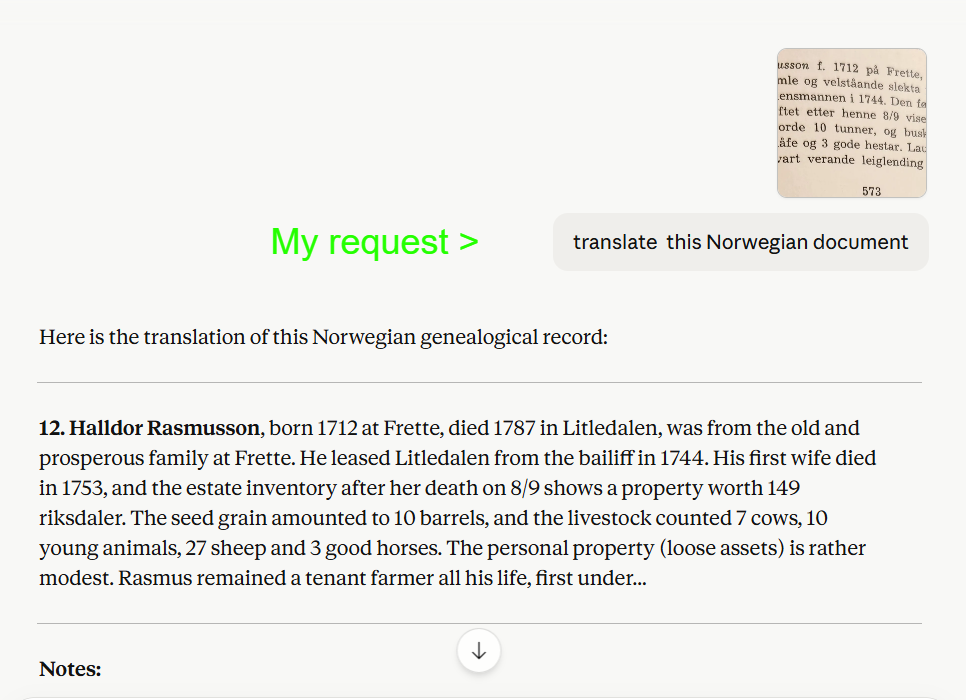
Green text is added to this exchange with Claude AI
When you click the down arrow it even explains the Norwegian abbreviations! This is what it told me.
Notes:
“f.” = født (born), “d.” = død (died)
“bygsla” = leased/rented farmland (a common tenure arrangement in old Norway)
“lensmannen” = the local bailiff/sheriff
“rdlr.” = riksdaler, the currency of the time
“Lausøyret” = movable personal property/chattels
“leiglending” = a tenant farmer who leased land rather than owning itThe text cuts off at the bottom of page 573 — there is more to the entry on the following page.
I am amazed that Claude knew what the document was (a Norwegian genealogical record) and could give me information like that about common abbreviations and words. Previously Google translate had used “built” for “bygsla” as well as other slight inaccuracies.
This was all free! I would be happy to pay a small subscription fee for such a terrific service.
I have also used Claude AI for handwritten German records. Some it did well. Others it found harder but it always told me why, discussing that horrible medieval German script.
AI is bringing in a wonderful new era for us family history researchers.
Thanks. I just tried Claude with a comment on a German birth record and it did an amazing job. Just think of all the time many of us spent in the past on decoding the handwriting in Bohemian Jewish vital records. AI will definitely make that job easier.
Ann, for German documents I have been most impressed by the Gemini AI, see my most recent blog post